Why We Started AIdea
AIdea began with a question: could AI create better opportunities to practise design thinking without replacing the human capabilities the work depends on?
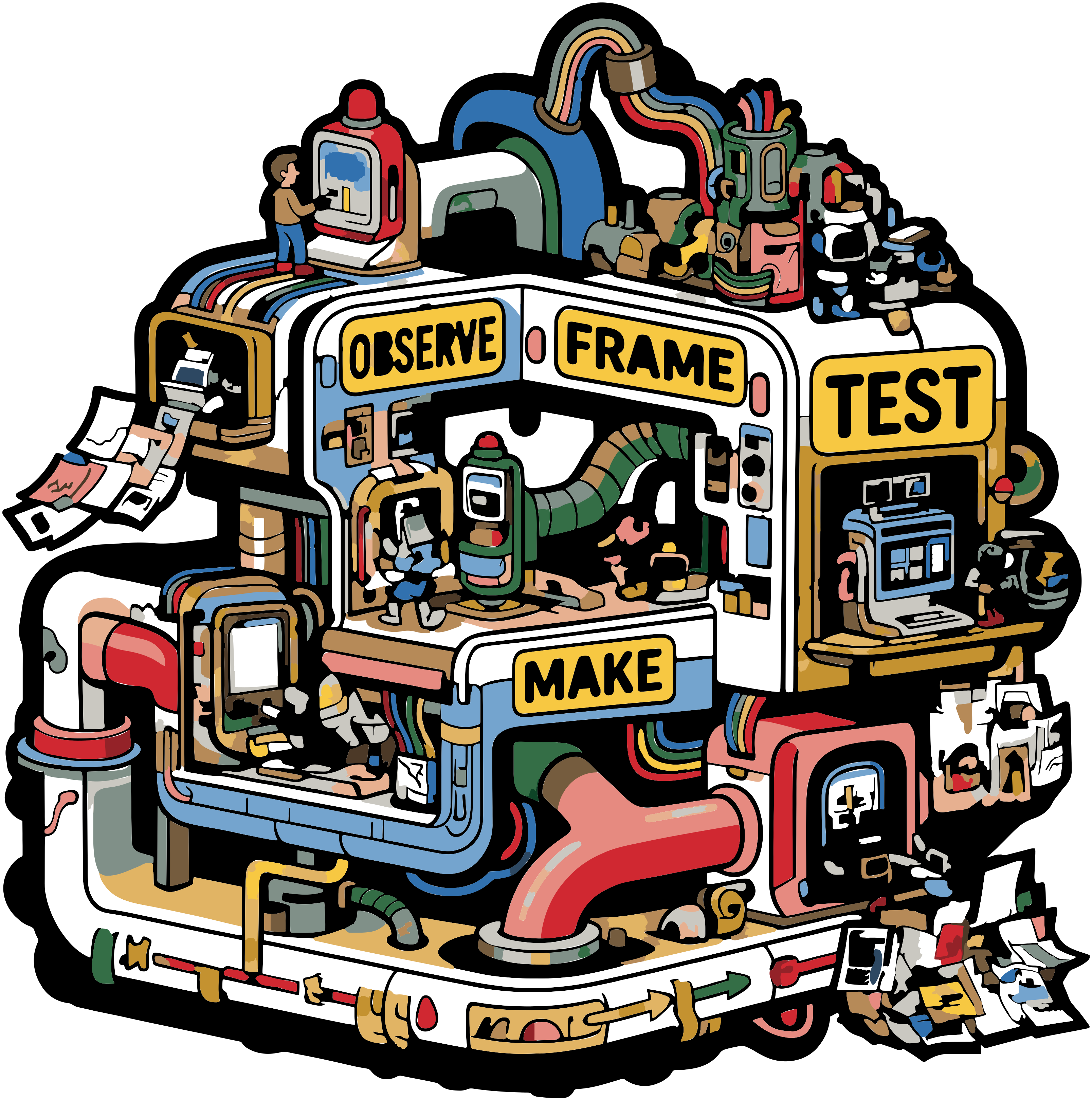
AIdea did not start with AI.
It started with a group of educators, designers and innovation coaches who had spent years teaching design thinking to very different groups: university students, professionals, teenagers and even primary-school children.
Across those experiences, we kept running into the same frustration.
A four-day hackathon can be energising. A one-day workshop can introduce powerful methods. But you do not become a design thinker in a few days.
Skills like interviewing, problem framing, synthesis, critical thinking and reflection take practice. Learners need to try things, make mistakes, receive feedback and try again.
We realised that we were not only interested in teaching the design thinking process.
We wanted to understand how people could actually become better design thinkers.
And that is where AI entered the conversation.
What if AI could help people practise?
When generative AI became more accessible, our first question was not: How can we add AI to a design thinking course?
It was:
Could AI help create better opportunities to practise?
Imagine a student rehearsing an interview with a simulated user before speaking to a real person.
Or receiving feedback on the questions they asked.
Or practising how to analyse an interview, frame a problem, challenge an assumption or reflect on a design decision.
Used in this way, AI could become a practice partner: available when the learner needs it, able to give immediate feedback and capable of creating many more moments for deliberate practice.
That possibility became the starting point for AIdea.
But almost immediately, a second question appeared.
AI is also changing design practice itself
The same technology that could help us teach design thinking was already changing how design work was being done.
Designers were using AI to summarise interviews, organise research, generate ideas, produce prototypes and support decision-making.
That raised a different set of questions.
When does AI genuinely make design thinking stronger?
When does it start doing the thinking we want people to learn?
What can we responsibly hand over to synthetic intelligence?
And which capabilities should remain deeply human?
From that tension, the two sides of AIdea emerged:
What can AI mean for the design thinking practitioner?
And:
What can AI mean for the design thinking educator?
What AIdea is
AIdea is a two-year European project exploring how generative AI can strengthen both the practice and the teaching of design thinking.
For practitioners, we explore practical human–AI workflows across research, synthesis, ideation, prototyping, testing and reflection.
For educators, we investigate how AI can support deliberate practice through simulations, micro-exercises, feedback and reflection.
Across both tracks, we work from the same principle:
AI should strengthen human capability, not quietly replace it.
That means using AI to create more opportunities for thinking, reflection and experimentation — not fewer.
What we are creating
The project will turn what we learn into five open results.
The AIdea Student Guide will offer practical activities for using AI responsibly within design thinking.
The Teacher Toolkit & Bootcamp will help educators experiment with AI-supported practice, simulations, feedback and reflection.
The Manifesto & Policy Brief will translate project insights into guidance for responsible AI use.
The Educator Ambassador Network will connect educators and practitioners across Europe.
And Video Tutorials will show practical examples of how human–AI collaboration can work in design thinking.
Who is behind AIdea
AIdea brings together six European partners with complementary experience in design, education, innovation and learning.
Coöperatie DOON coordinates the project and contributes expertise in design thinking, innovation and learning design.
Avans University of Applied Sciences brings research and practice in design thinking, business innovation and AI-supported learning.
RHIZO contributes secondary-school practice and extensive experience in teaching and developing design-thinking methods.
Merletcollege brings expertise in Technasium, STEM and project-based learning.
AllGrow contributes design-thinking curriculum development and educator training in Romania.
OSENGO brings experience in vocational education, digital learning and AI training from France.
What connects us is not that we already have the answers.
It is that we share the same question.
We know design thinking can create powerful learning experiences. We also know that experiencing the process once is not enough.
AI gives us a new opportunity to explore how learning can become more deliberate, more personalised and more effective.
At the same time, it forces us to ask what should remain unmistakably human.
That is the experiment behind AIdea.