Two Days in Den Bosch: What We Learned About Working AI-First
What the AIdea partners learned about working AI-first, moving human effort towards direction, judgement and alignment, and making room for better conversations.
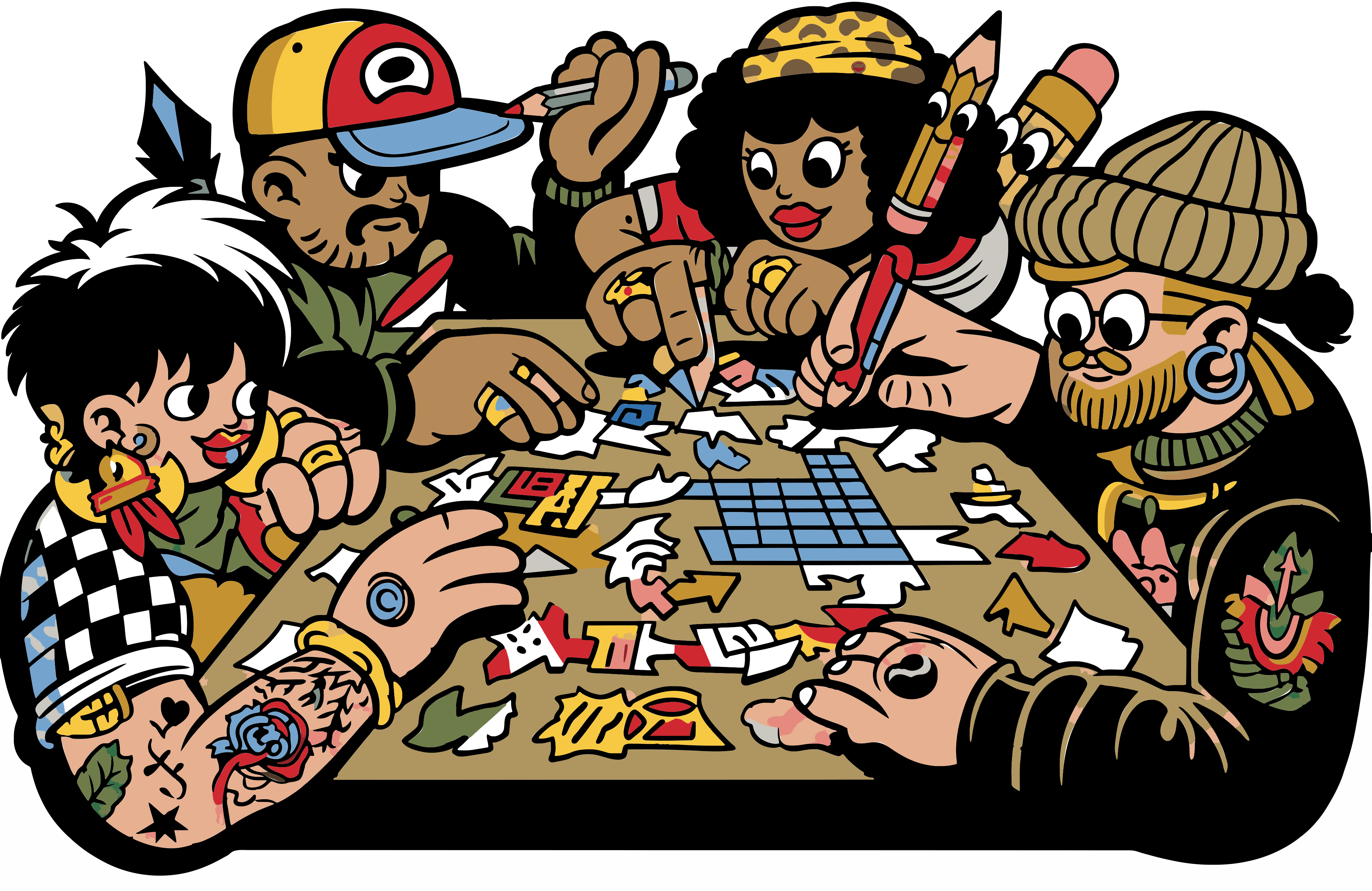
In June, the AIdea partners met for two days at Avans University of Applied Sciences in Den Bosch.
After months of online meetings, research and preparation, being in the same room mattered.
Not because we needed more slides or another project plan.
We needed to make choices together.
What should AIdea really focus on? What should our results become? And if the project is about how AI is changing design work, should that also change how we work as a project team?
That last question became one of the most useful parts of the meeting.
From research to decisions
We arrived with plenty of input.
Our desk research had explored what AI may mean for design thinking and design education. Our user research had surfaced what students and educators struggle with. And the project proposal had already given us a direction: create practical resources, test them, and share what works.
But research gives you possibilities.
At some point, you still have to choose.
Over the two days, we worked on the learning outcomes, prototypes and direction of our two core tracks:
What can AI mean for the design thinking practitioner?
And:
What can AI mean for the design thinking educator?
Having Avans, DOON, RHIZO, Merletcollege, AllGrow and OSENGO around the same table helped enormously.
The value was not that everyone agreed immediately.
The value was that we could question each other, explain what mattered, and gradually arrive at something we could all stand behind.
Then we made another decision: work AI-first
At some point, a very obvious question surfaced.
If AIdea is exploring what AI changes, why should we run the project in exactly the same way we would have five years ago?
So we started experimenting with an AI-first way of working.
Even during the meeting, this showed up in a simple way: AI helped capture and structure our notes while we talked.
That may sound minor, but it changed the room.
Fewer people were focused on documenting every sentence. More people could stay in the conversation.
And from there, a bigger question followed:
What other work are we still doing manually simply because that is how we have always done it?
Move one layer up
One idea stayed with us after the meeting:
Be the director. Let AI do more of the execution.
That does not mean handing over responsibility.
It means changing where human attention goes.
We define what needs to be created. We provide context. We set criteria. We review the output. We reject weak work. We redirect when necessary.
AI can increasingly handle parts of the execution underneath that.
We tested this immediately with one of our first project results.
Originally, we planned to ask partners to manually search for examples of designers using AI, document them, and add them to a shared repository.
Instead, we focused first on designing the research process.
Where should we look? Which people or sources matter? What makes a case useful? What information should we capture?
Once those criteria were clear, AI could take on much more of the searching and documentation.
Our role shifted from doing every step ourselves to designing and supervising the process.
That distinction feels increasingly important.
The place where work starts is changing
We also noticed something broader.
For years, knowledge work usually started inside the application where the final result would live.
A report started in Google Docs.
A spreadsheet started in Sheets.
A presentation started in PowerPoint.
Increasingly, that is not what happens.
We start in ChatGPT, Claude or another AI environment.
We discuss the task. Add source material. Explore options. Ask for critique. Shape the structure. Generate a first version.
Only then does the work move into Docs, Sheets, Figma or another familiar tool.
Those tools are not disappearing.
But the place where the work begins is shifting.
That matters for AIdea too.
We do not want to create guidance that depends on one specific tool or one button that may disappear next year.
We want to focus on the capabilities underneath: how to frame a task, give useful context, judge an output, recognise what is missing and know when to intervene.
The tools will change.
Those skills will last longer.
Faster AI may require slower humans
Perhaps the most important lesson from Den Bosch was not really about AI at all.
AI can generate a strategy in seconds.
It cannot create genuine alignment between six people.
It can propose twenty directions.
It cannot decide which future a team actually wants to commit to.
It can record every sentence in a meeting.
It cannot replace the trust built by sitting together, disagreeing, explaining why something matters and slowly arriving at a shared understanding.
As AI makes production faster, some of the most valuable human work may look surprisingly inefficient:
Conversation.
Relationships.
Critical reflection.
Creative leaps.
Making sense of ambiguity together.
In fact, the faster the work after the prompt becomes, the more important the conversation before the prompt may become.
What we left with
We did not leave Den Bosch with a finished toolkit or a final answer to how AI should be used in design thinking.
We left with something more useful at this stage: direction.
We had prototypes to develop, practical use cases to gather and a clearer picture of what our two AIdea tracks should become.
But we also left with a principle we want to keep testing:
If AI changes the nature of the work, we should allow it to change how we organise the work too.
Move human effort towards direction, judgement and alignment.
Let AI handle more of the repetitive execution where it makes sense.
And use some of the time we gain for better thinking and better conversations.
For a project exploring the future of human–AI design practice, that feels like a good place to begin.